October
Study Day, Callington u3a
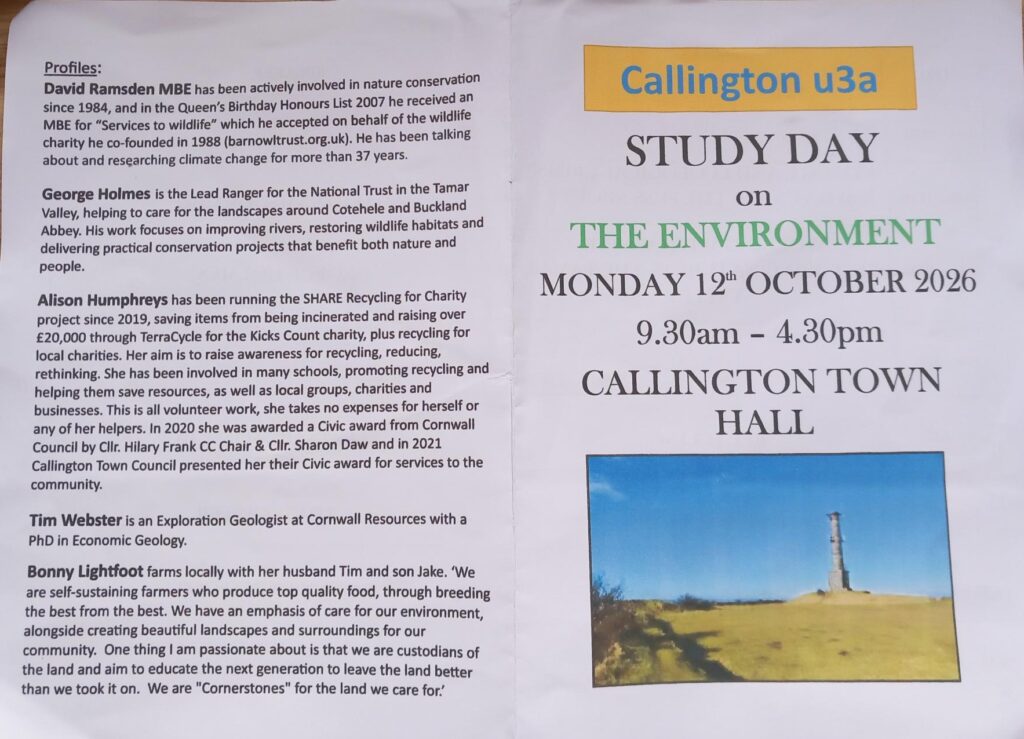
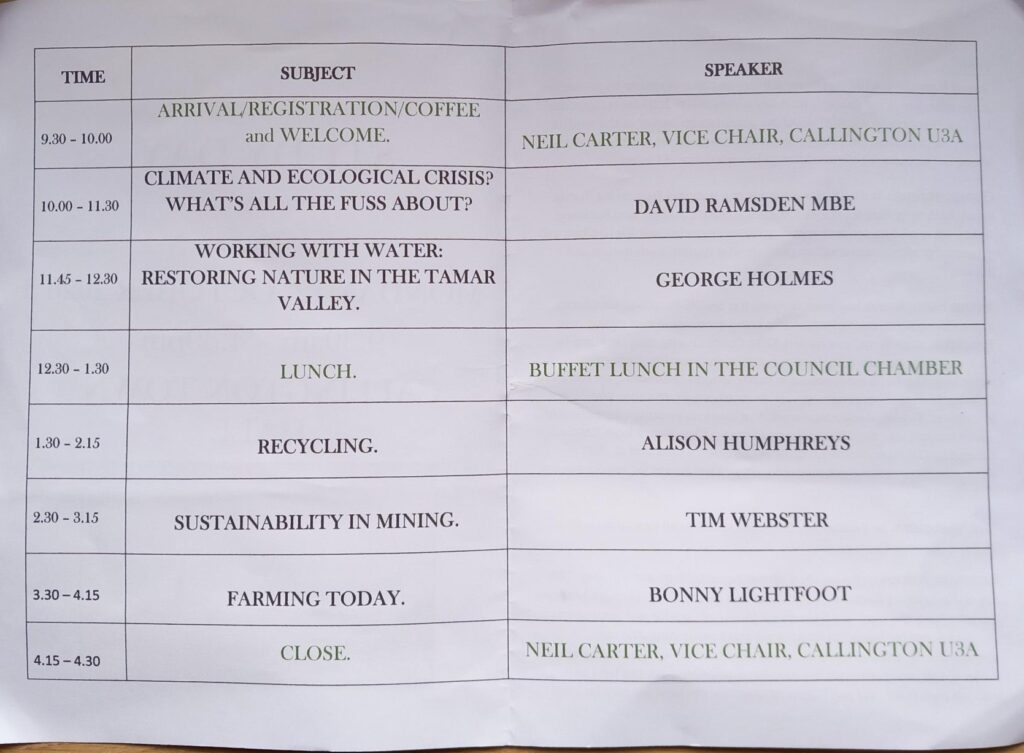
on Monday 12th october, 5 members of Moor's Edge u3a went to a study day held by Callington u3a in Callington Town Hall. The subject was The Environment.
The first speaker was David Ramsden MBE on climate change and why we should be concerned. with the aid of lots of clear diagrams, he explained how our planet keeps its climate balanced by 5 different mechanisms. It only takes 1 of those mecchanisms to misalign for the planet to become uninhabitable.
Scientists have calculated that we need to keep climate warming to below 1.5° to prevent this happening, but current government pledges aren't enough to have any effect. We should reach that figure by 2030, with 2° by 2037 and 4° by 2100. If that sounds scary, he then went on to talk about the tipping point. This is the point of no return. We reached that point in 2025.
If every person on the planet suddenly turned very planet friendly, we wouldn't reverse the damage we've done, just buy ourselves more time. If you wish to know more about this, go to www.nebriefing.org and watch the video "National Emergency Briefing on Climate and Nature" which is about 50 minutes long. It is an abridged version of a meeting at Westminster Central Hall on November 27th 2025.
Our second speaker was George Holmes who is lead ranger for the National Trust at Cotehele, Buckland Abbey and Cadsonbury.
All three sites are close to rivers and are finding increasing problems with rising water levels. The River Tamar levels are rising by up to 1/2 metres more than it used to.
To alleviate this problem, the NT are working to create wetlands, woodland and healthy grasslands that can soak up the extra water. the motto they are using is "think like a beaver". Dams have been created using whatever was available on the sites, so some dams are loose structures and others are much denser.
There has been increased tree planting, mostly fuit and nut trees, with the aim of 20 million trees by 2030. Meadow creation, especially flower meadows, was done using seeds from other local areas.
All this has led to an increase in wildlife like dormice and otters.
The third speaker was Alison Humphreys who helped start SHARE, which stands for South Hill Association for renewable Energy. South Hill is just NW of Callington.
Alison listed all the products that can be recycled and where they are sent to for that to happen. Some items even get sent abroad which doesn't sound very planet friendly.
Alison's talk was very specific to the area of Cornwall around Callington, but those of us from Moor's Edge all live in Devon. This meant we had to disagree with some of her comments.
The fourth speaker was Dr Tim Webster. He had only found out that morning that he was presenting a talk which was meant to be given by another speaker. The talk was about sustainability in mining by Cornwall Resources Ltd. (CRL)
It would appear that the company want to open a new mine near Kelly Bray extracting tungsten, copper and tin. The mine has been 2 years in the planning with CRL working with the local population to ensure minimal disruption to the environment. Dr Webster started the talk by saying he was not an expert on the subject and would be unable to answer any questions. This didn't stop some of the audience giving him a hard time, asking questions he couldn't answer.
The fifth and final speaker was Bonny Lightfoot, a local farmer. Bonny, with her husband Tim and Son Jake, run an organic farm at Stoke Climsland on land partly owned by the Duchy of Cornwall. Alren Farm is a beef and arable farm. The cattle are Charolais cows, fed with farm grown barley, wheat, beans and beet. The meat is sold to M&S, Lidl's and Costco. The farm has received awards from M&S for the quality of their beef.
To prevent excessive rainwater runoff, the farm has purchased a sward lifter which cuts fine drills in the soils. They has also enlisted the ladies of the local WI to build leaky dams, slowing the flow of water and allowing the ground to absorb more of it.
Bonny listed the many things they need to do to keep their organic status. Many trees have been planted, especially local apple, pear and plum varieties. They have established 20 metres of wildlife margins around the arable fields, and they have 1 1/2 hectares of winter bird seeds including sunflowers, corn and grasses. This has rewarded them with a wide range of rare birds, mammals and insects.
Of the 5 talks, I personally liked the first and last ones best. One told us all the things we are doing wrong to our planet and the other was given by a person trying to help our planet.
July
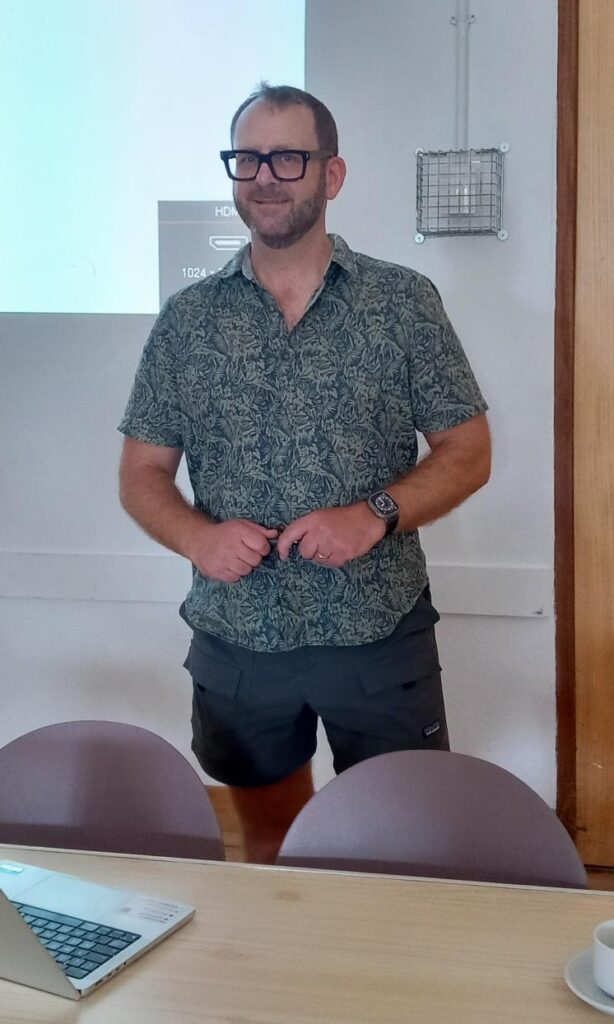
This month's presentation was from Matt Mullen on AI. Matt is the son of our secretary and had been given strict instructions to keep his presentation friendly and not scary. I think he managed to do that very well.
He started by listing some of the times we may be using AI without ever realising it; things like Facebook, Amazon, Netflix, Google, Alexa and even our sat-nav. It appears that virtually all of us are using some form of AI without being aware of it.
Matt told us that AI is not true intelligence like humans, but is very good at predicting and giving an appropriate response. However, when AI doesn't know the answer, it makes things up. That sounds like a few humans I know.
Will AI take away our jobs? Matt says no, we will just adapt. AI can't replace human intuition and collective knowledge. Society went through a massive change during the industrial revolution. The same thing is happening now in a digital revolution.
The presentation was thought-provoking, but quite encouraging at the same time. Many of us had questions and concerns about the future of AI and Matt managed to answer all our questions.
June
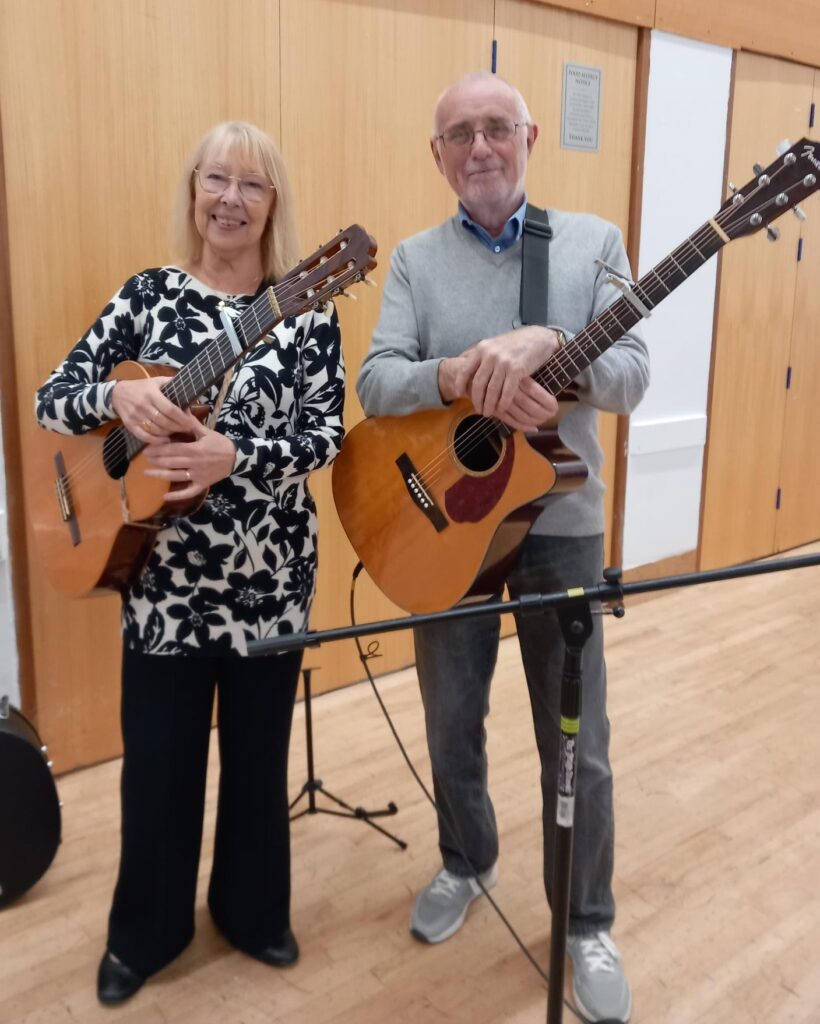
This month we had a return visit from the singing and guitar group Silvington. The theme this time was "tales of the Tamar".
First they told us about the legend of the Tamar River. A water nymph called Tamara wanted to be with two giants called Tavy and Torridge. Her father did not approve and turned her into a river. The two giants asked to be turned into rivers so that they could join her. Today the River Tavy flows into the River Tamar, but the River Torridge got lost, travelled north and flows into the Bristol Channel.
A selection of songs were sung about the people who lived and worked along the Devon side of the Tamar, especially within the mining community. Their lives were hard and brutal.
At the end of the presentation, the singers told us something interesting about their guitars. One uses nylon strings and the other uses steel strings. In theory, this shouldn't be a harmonious combination. They have managed to overcome that and you won't know that their was this difference.
May
General Meeting

Our speaker this month was Andy Curtis from the National Coastwatch Institution.
"Eyes along the Coast"
The NCI is a charity staffed and managed by volunteers whose job it is to help save lives at sea and around our coastline. They are part of the UK Search and Rescue, working along side the coastguard, the RNLI and other "blue light" emergency services. They don't get involved in any rescues, their job is just to watch and listen. If they become aware of an emergency, they contact the appropriate services.
Our speaker was from the Rame Head Lookout Station situated on a historic outcrop of land. It was from here that the Spanish Armada was first spotted. A beacon was lit and Sir Francis Drake was informed while playing bowls on the Hoe, so the legend goes.
Horse Drawn Barge Trip
8 members made their way to Tiverton on a rather cool day, with a forecast of rain showers.
At the entrance to the Canal Company, we were met by Dave who introduced us to the whole crew including Brinkley the horse and Tilly the dog.
Dave gave a short history of The Great Western Canal which was built between 1812 and 1814. It was designed to carry limestone from the local quarry to the lime kilns. It was always intended to be a much longer canal going all the way from Bristol to Exeter, but was never completed due to the emergence of the railways. Today just a short 11 mile section remains and its only commercial traffic is the horse drawn barge. The quarry is still in operation today, but uses lorries for its transport.
The barge travelled out of Tiverton into the countryside. As we passed along the canal we saw many Mallard Ducks and Moorhens. there were also some ducklings, but not the Canada Geese goslings or Kingfishers that are sometimes seen. The verges were lined with flowering water irises and emerging, but not yet flowering, water lilies.
On the way back, Dave suggested opening the windows and having 2 minutes of total silence so that we could appreciate the peace of the canal. It was lovely, if a little chilly.
After the barge trip we all made our way to The Globe Inn at Sampford Peverell for lunch. This pub is next to the canal we had just travelled on, but further along than we went. It was very spacious inside with a good selection of food especially the puddings (3 choices for cheesecake!).
We arrived back in Plymouth at 4:30 pm having managed to dodge all the rain showers.

